

Market Event Update from Evidentia, 6 October 2026
Why have bond returns recently been lower?
Persistent inflation, changing interest rate expectations and rising oil prices have pushed bond yields higher and prices lower. Initially, longer-term bonds were most affected, but shorter-term bond prices have also fallen as markets have priced in further interest rate rises. While this has weighed on recent returns, it has also increased the income now available from bonds.
How do bonds work?
A bond is effectively a loan made to a government, company or other borrower. In return, the investor generally receives regular interest payments, known as coupons, and the repayment of the bond’s face value at maturity, subject to the issuer’s ability to meet its obligations.
The relationship between bond prices and yields
Bond prices and yields move in opposite directions. Expectations that interest rates will remain higher for longer, alongside renewed inflation concerns, have pushed bond yields higher, reducing the value of existing lower-yielding bonds. While this has weighed on bond prices, higher yields also mean greater income and improved return potential going forward.
Yields do not need to fall for returns to improve. If they stabilise, higher income can contribute more fully to returns, while an eventual decline in yields could also support a recovery in bond prices.
| What happens to yields | Likely effect on bonds |
|---|---|
| Yields rise further | Prices may fall, partly offset by higher income |
| Yields stabilise | Higher income becomes the main driver of returns |
| Yields fall | Higher income is supported by rising bond prices |
Why is the outlook now more encouraging?
The current environment for bonds is meaningfully different from the period when yields were close to historic lows. Investors are now being offered substantially more income for holding high-quality bonds, while bonds may also benefit if economic growth slows and interest rates eventually decline.
Three factors support a more constructive medium-term outlook.
1. Higher yields have improved future return potential
A bond’s starting yield is an important indicator of its potential return if held to maturity and the issuer meets its obligations. With yields above multi-decade averages in many markets, bonds now offer more income, a larger buffer against price declines and more attractive rates for reinvesting coupon payments.
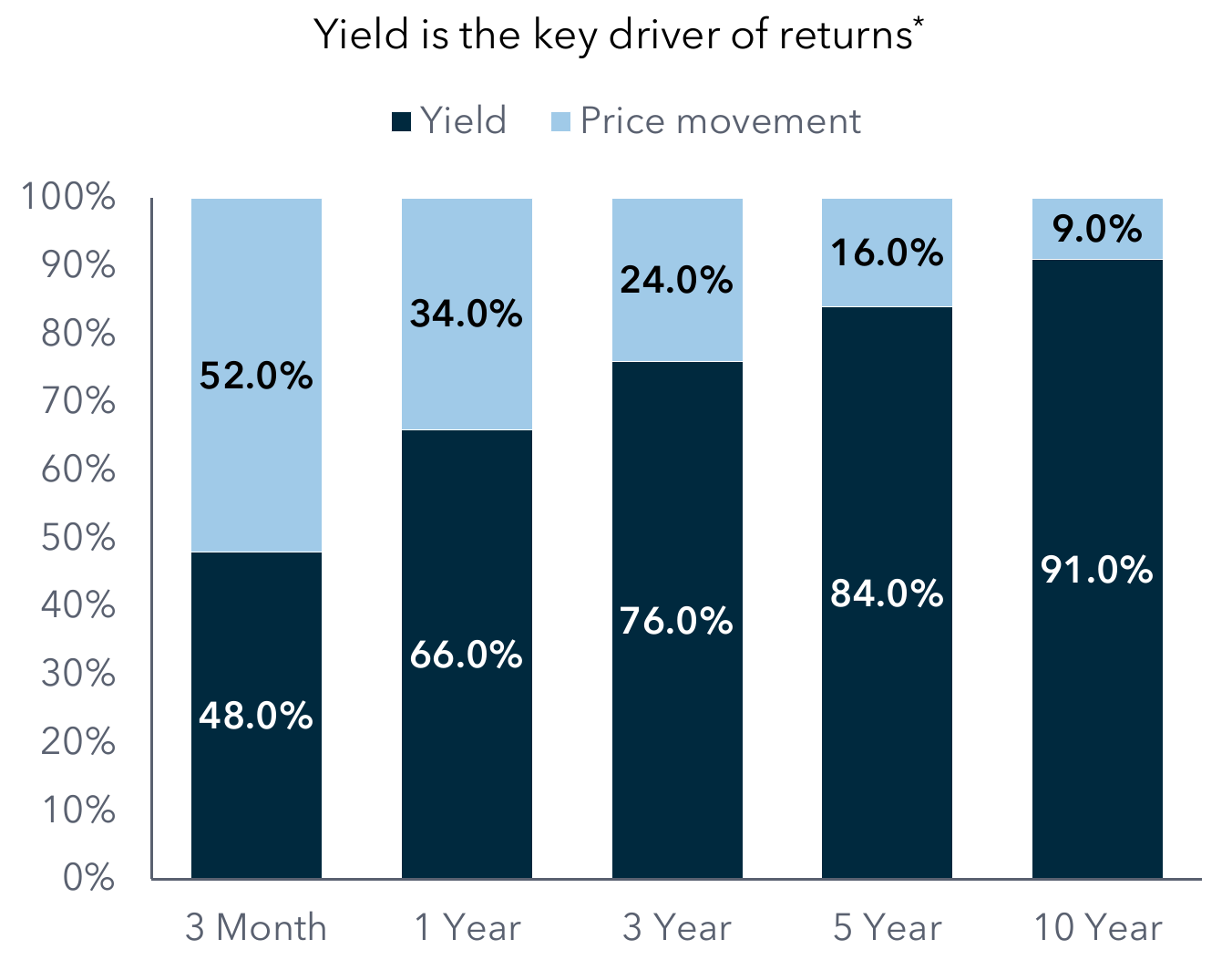
The chart above shows that, over the long term, bond returns are driven mainly by their starting yield. Today’s higher yields provide a stronger foundation for future returns, despite short-term price movements.
2. Australian bonds may provide valuable portfolio protection
High-quality Australian bonds, including inflation-linked bonds, present an attractive opportunity. If higher interest rates weaken economic growth, the Reserve Bank of Australia may have greater scope to lower rates, supporting longer-duration bond prices. This could allow Australian bonds to provide higher income and portfolio protection during periods of economic or share market weakness.
3. Global bond yields are also offering better compensation
The outlook for global fixed interest is balanced, with yields above 5% after hedging currency exposure back into Australian dollars. While inflation and government borrowing may keep yields elevated, current income provides better compensation for these risks than in recent years.
Not all bonds offer the same opportunity
Although the outlook for fixed interest has improved, opportunities vary across the market:
Government bonds
Australian government bonds currently offer attractive income and potential to benefit if slower growth leads to lower interest rates. Global bonds also offer improved income, although inflation and government borrowing remain risks.
Investment-grade corporate bonds
Investment-grade corporate bonds offer reliable income, but the extra income above government bonds is currently limited, reducing the reward for taking on additional company risk.
Global high-yield bonds
Less attractive, with the extra income above government bonds currently limited relative to the greater risk of company defaults or weaker economic growth.
Cash
A useful short-term defensive allocation while the additional income offered by corporate bonds remains limited.
What if inflation stays high and growth slows?
Australian bonds are favoured because higher interest rates are already having a more direct impact on households and economic growth in Australia. This increases the potential for Australian bonds to benefit if growth slows further. Global bonds remain more balanced as inflation and interest rate uncertainty remain elevated, while cash provides additional stability.
Looking beyond recent returns
The bond market’s reset has been challenging, but it has cleared the way for a brighter medium to long term return outlook. There may be more volatility in the short term due to the ongoing conflict in the Middle East and upside risks to inflation. But higher yields now offer stronger income and greater resilience, while Australian bonds in particular are well placed to benefit if economic growth slows. With a selective approach to global and higher-risk corporate bonds, high-quality bonds remain a valuable source of income, diversification and portfolio protection.
We’re here to support you through all market conditions. If you have any questions or would like to discuss anything about your portfolio in more detail, please don’t hesitate to reach out.
The information contained in this document is provided by Evidentia. Evidentia means Evidentia Group Holdings Pty Ltd ACN 665 634 382 and its related entities. All financial services included in this communication are authorised by Evidentia Financial Services Pty Ltd ACN 664 546 525 AFSL 546217. It is general information only and does not constitute financial product advice. If any statements made (either alone or together) constitute advice, then the advice is general advice only and does not take into account anyone’s objectives, financial situation or needs. Before making an investment decision based on this material you should consider whether it is appropriate to your particular circumstances. Where the material relates to the acquisition or possible acquisition of a financial product, you should obtain a disclosure document relating to the product and consider the content before making any decision about whether to acquire the product. Please refer to your financial adviser for further details and any disclosure documents relevant to you. This document is based on information considered to be reliable. It is based on our judgement at the time of issue and is subject to change. No representation, warranty or undertaking is given or made in relation to the accuracy or completeness of the information presented in this document. Except for liability that cannot be excluded, Evidentia, its directors, employees, agents, and related bodies corporate disclaim all liability in respect of any error or inaccuracy in, or omission from, this document and any person’s reliance on it. This material is not intended for distribution to, or use by, any person or entity in any jurisdiction or country where such distribution or use would be contrary to local law or regulation. If this document contains any performance data, then performance is not a reliable indicator of future performance.